
If your Airbnb is not getting bookings, the problem is usually not one dramatic flaw. It is usually a chain of small leaks: a vague title lowers clicks, the wrong hero photo weakens desire, the description fails to remove doubts, and recent reviews do not give guests enough trust to book.
Start with the listing page before you lower your price. A discount can create bookings, but it also teaches the market that your place needs a discount. The better first move is to find the exact place where guests lose confidence.
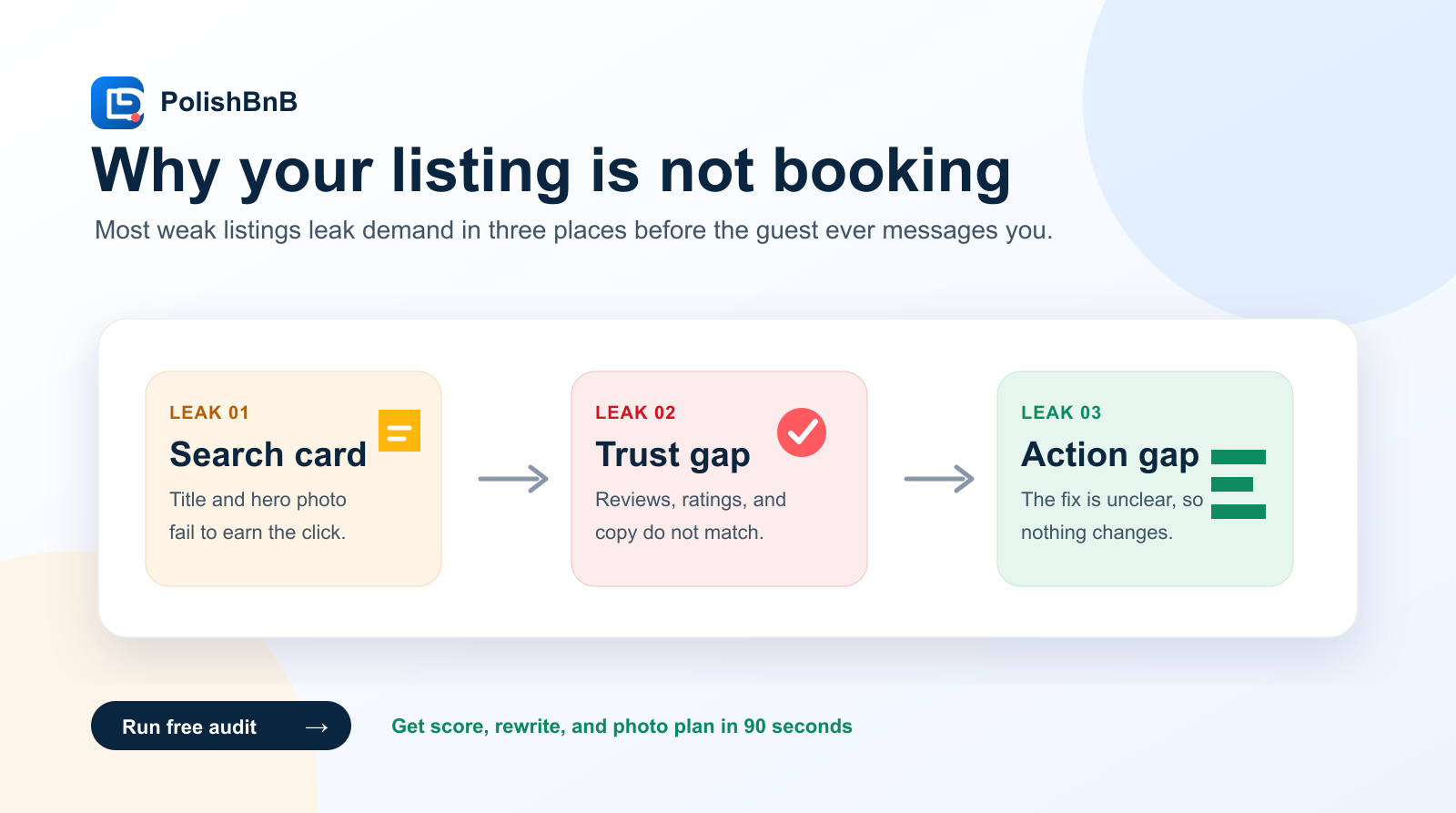
The 7 listing leaks to check first
Use this order. It mirrors the guest journey: search result, click, scan, trust, compare, then book.
1. Your title is too generic
A weak title says what the property is. A strong title says why this stay is worth clicking.
Bad titles usually sound like this:
- Cozy apartment near downtown
- Beautiful beach house with wifi
- Spacious 2 bedroom condo
The problem is not that these are false. The problem is that Airbnb already shows property type, location, beds, rating, and price in the search card. Your title should not repeat what the card already says.
Use the stronger formula:
Vibe + specific feature + audience hint
Examples:
- Walkable beach cottage - deck sunsets for four
- Quiet Capitol Hill loft with desk and blackout curtains
- Dog-friendly cabin with wood stove and creek trail
If you cannot name one specific feature, that is a positioning problem, not a writing problem.
2. Your first photo is not the decision photo
Guests do not click the most technically beautiful photo. They click the photo that answers: "Do I want to be there?"
For a beach rental, that might be the deck, the view, or the brightest living room. For a city apartment, it might be the window, workspace, or best-designed room. For a cabin, it might be the wood stove, bed, deck, or surrounding trees.
Do not lead with:
- exterior front door photos
- close-ups of coffee mugs
- dark kitchens
- bathrooms
- a couch shot with no window or focal point
Exterior photos build trust, but they rarely create desire. Put them later unless the exterior is the experience.
3. Your description opens with a greeting
"Welcome to our cozy home" wastes the most valuable sentence on the page.
The first line should create a picture or remove a major doubt:
- Wake up 80 feet from the sand, coffee already on the deck.
- A quiet work-from-here loft with blackout curtains and 300 Mbps wifi.
- Built for families of four who want real beds, parking, and a walkable beach.
Guests skim. The first sentence has to carry the listing's angle.
For a full structure, use the four-block format:
- Vibe: one sensory opening.
- Fit: who the place is best for.
- Proof: concrete details guests can verify.
- Logistics: check-in, parking, quirks, and soft CTA.
4. Your listing hides the proof
Most hosts write "great location" when they should write "8 minutes to Pike Place." They write "fast wifi" when they should write "300 Mbps tested at the desk." They write "fully stocked kitchen" when they should name the espresso machine, child plates, or sharp knives.
Specifics make the listing feel managed. Vague claims make it feel copied.
Add proof in four places:
- title: one specific reason to click
- first paragraph: one sensory or location proof
- amenities section: real differentiators, not every basic item
- photo captions: explain what the guest is seeing
5. Reviews are telling a different story than the listing
If recent reviews mention "communication was slow," "parking was tight," "smaller than photos," or "hard to find," your description needs to address that directly.
Do not hide known friction. Hidden friction turns into disappointment. Named friction turns into informed consent.
Examples:
- "Parking fits one compact car; larger SUVs should use the paid lot one block away."
- "The bathroom is small but newly updated, with strong water pressure."
- "Street noise is possible on weekends; white-noise machine provided in both bedrooms."
This kind of honesty often improves conversion because it increases trust.
6. Your price and story do not match
A listing can be fairly priced and still feel expensive if the page does not explain the value.
At higher nightly rates, guests need more proof:
- better first photo
- clearer sleeping setup
- stronger review signals
- exact walking distances
- premium amenities named directly
- fewer surprises in house rules
Before cutting price, ask: "Does the listing page make this price feel obvious?"
If not, fix the story first.
7. You have no next action
Many hosts know their listing is underperforming but do not know what to change first. That is why they tweak random sentences, reorder random photos, or lower the price too early.
A better plan is:
- Rewrite the title.
- Swap the first photo.
- Fix the first sentence.
- Add 3 concrete proof points.
- Address one recurring review complaint.
- Re-audit after the next booking cycle.
Small changes beat broad rewrites because you can see what moved.
Quick diagnostic checklist
Use this 10-minute check:
| Question | If the answer is no |
|---|---|
| Does the title name a specific feature? | Rewrite it with the 3-slot formula |
| Does photo 1 create desire? | Move the best lifestyle/view photo first |
| Does the first sentence paint the stay? | Replace greeting with sensory hook |
| Does the copy cite real proof? | Add distances, speeds, bed setup, brands |
| Do reviews match the promises? | Address recurring friction directly |
| Does the price feel justified? | Add premium proof before discounting |
| Is there one obvious fix to do today? | Create a 3-item action plan |
The fastest way to find your leak
Paste your Airbnb URL into PolishBnB. The free audit scores the listing and shows the three sharpest leaks. The full report gives you the rewritten title, 500-character description, photo plan, and PDF checklist.
No Airbnb login. No card for the free summary. Just the public listing page, read the way a guest reads it.